
Sunny Sprouts’ aim is to help fellow Child Development students (and anyone else who is interested!) understand important concepts and theories related to our field. Sometimes all of the different types of theories, main ideas, and terms are confusing and can easily be mixed up. My hope for this new series is to help clarify any of these confusions.
So without further ado, welcome to Theory Inquiries!
Let’s first begin by defining the term theory. In normal or colloquial terms, theory is defined as an abstract idea made without the basis of research.1 This often leads people to confuse the validity of psychological or scientific theories.
In psychology, the term theory is defined as “an orderly set of integrated statements that describes, explains, and predicts behavior.”2 These integrated statements are created on the basis of empirical research and evidence and often go through vigorous levels of review before they are published. These theories are important because they serve as a framework for our observations with children, and allow us to have a starting point for practical action.2
For a more in-depth explanation of psychological and scientific theories, check out this article!
Though there are many theories in Child Development, there are common themes within them. No matter if we’re talking about Piaget or Vygotsky, Bronfenbrenner or Erikson, there are commonalities to look for between each of them. Once you recognize these commonalities, it makes it easier to understand these theories and their main ideas. These themes include Nature vs. Nurture, One Course or Many, and Continuous vs. Discontinuous.
Nature vs. Nurture
No doubt that this is a popular debate! This theme discusses whether or not children’s development is influenced primarily by nature (the child’s genetics or biology), or nurture (the way others interact with the child; their socialization).
In other words, it questions the significance of genes versus the significance of the environment the child is reared in.2 However, most theories combine both ideas and say that both nature and nurture impact the child and their development.
All theories will somehow discuss nature and nurture, but they will place different emphases depending on whatever they see best explains individual differences. For example, behaviorism emphasizes nurture as it stresses the importance of conditioning and modeling. In contrast, the nativist theory emphasizes nature and the importance of biological factors such as the genetic code.3 The psychosocial theory by Erikson places significance on both nature and nurture. It views a child’s development as a combination of biological impulses and child-rearing experiences, which in turn controls these impulses.2

One Course, or Many?
Courses refer to the contexts (or environments) in which a child grows up. These contexts are often multi-layered and complex. Theories that refer to one course assume that the context the child is in is universal, and every child will go through the same thing. For example, Piaget’s Cognitive Development Theory advocates one course. All of Piaget’s stages in cognitive development are assumed to be universal, and each child will experience the same thing. Each child’s path to development is the same.
In contrast, Vygotsky’s Sociocultural Theory advocates many courses. It assumes that children’s contexts vary from culture to culture, environment to environment. Each child’s path to development is different.

Continuous vs. Discontinuous
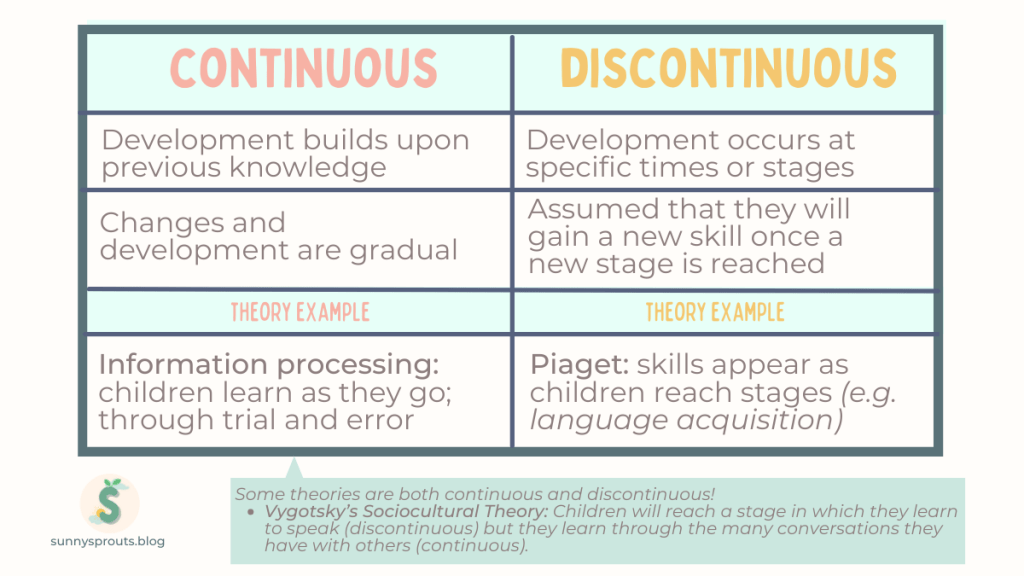
Continuous vs. discontinuous theories of child development discuss the way children develop skills. Continuous refers to skills that builds on to previous skills children have already learned and mastered. Changes and development are gradual. For example, Behaviorism and Information Processing Theory are continuous, as development occurs as the child learns, essentially through trial and error.
Discontinuous refers to newly developed skills that appear at specific times or stages. Once a child reaches a certain stage or age in life, it is assumed that they will gain a new skill. An example of a discontinuous theory is Piaget’s Cognitive Development Theory, which we briefly discussed previously. As mentioned, Piaget believed that cognitive development occurs in stages, therefore the skills they learn will occur whenever they reach that time2.
Like nature and nurture, some theories can be both. Development builds upon previous skills and knowledge, but they occur in stages. This may be seen in Vygotsky’s Sociocultural Theory. Children will reach a stage in which they learn to speak (discontinuous) but they learn through the many conversations they have with others (continuous).
Conclusion
In short, there are many differences between theories and even between these common themes. However, there are also many similarities and points that may build upon each other to help us further understand children and their development.
I hope that this post was helpful! Please feel free to ask any questions or to correct me if any of my information is incorrect. Click here to download a PDF file of all the graphs included:
Happy Learning!
References
- Theory. Retrieved from https://www.goodtherapy.org/blog/psychpedia/theory
- Berk, L. E. (2018). Exploring Child Development. Pearson Education (US). https://bookshelf.vitalsource.com/books/9780134983813
- Denise Cummings-Clay, H. C. Child Development. Retrieved from https://courses.lumenlearning.com/atd-hostos-child-development-education/chapter/nature-vs-nurture/







 Sunny Sprouts by Miss Jane
Leave a comment