
I don’t know about you, but when I first learned about these concepts, I was a bit confused about how to use them. It seemed simple enough, but when it came to actually implementing these concepts in real life and having to prepare open-ended questions in my practicum class, I found myself stuck and confused between the two. So what’s the difference?
Open-Ended vs. Close-Ended
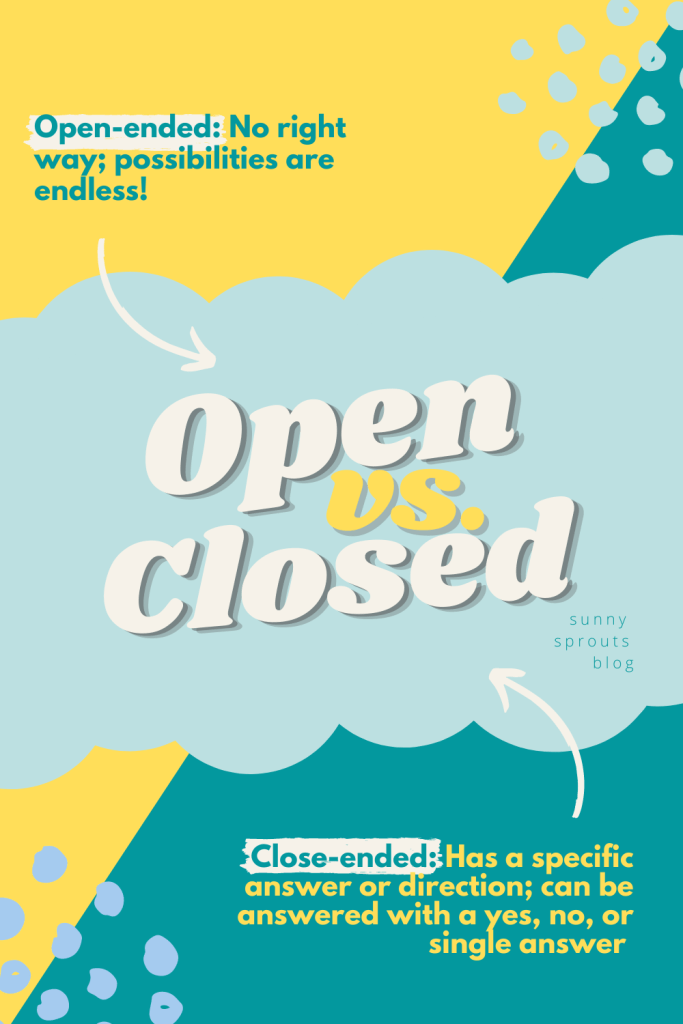
Open-ended aspects in child development, whether it be questions, materials, or activities, all have endless possibilities. Children can answer these questions however they please; there’s no right or wrong answer. No right or wrong way of using a material and no right or wrong way in going about an activity. Close-ended aspects, on the other hand, do have a right or wrong. Close-ended questions come with the expectation of a certain answer, materials have a certain use, and activities have a certain procedure.
Examples of Open-Ended Questions
- Why do you think this happened?
- How can we do this differently?
- How else could you do that?
- How could you…?
- How can we work together?
- What can you use to…?
- What is your favorite part about this?
- What did you see?
Examples of Close-Ended Questions
- How many buttons are on here?
- What color is this?
- Do you want to…?
- Who painted this?
- How many shapes do you see?
- Would you rather use crayons or markers?
- Do you like the book we read?
Open-Ended Materials
These include materials that have no specific directions and can be used in any way a child sees fit. These materials can also be easily incorporated with other items.
Some examples of Open-Ended materials include:
- Blocks
- Play Dough
- Clay
- Fabric
- Stones
- Sticks
- Rope
- Sand
- Leaves
- Stuffed Animals, dolls, figurines
- Boxes
Open-Ended Activities
Open-ended activities hold many benefits! These activities may help encourage a child’s creativity and imagination, as well as stimulate their thinking.
- Painting or drawing
- Sand sensory tables
- Water sensory tables
- Playing with play dough, slime, or kinetic sand
Open-Ended vs. Close-Ended: When to use them
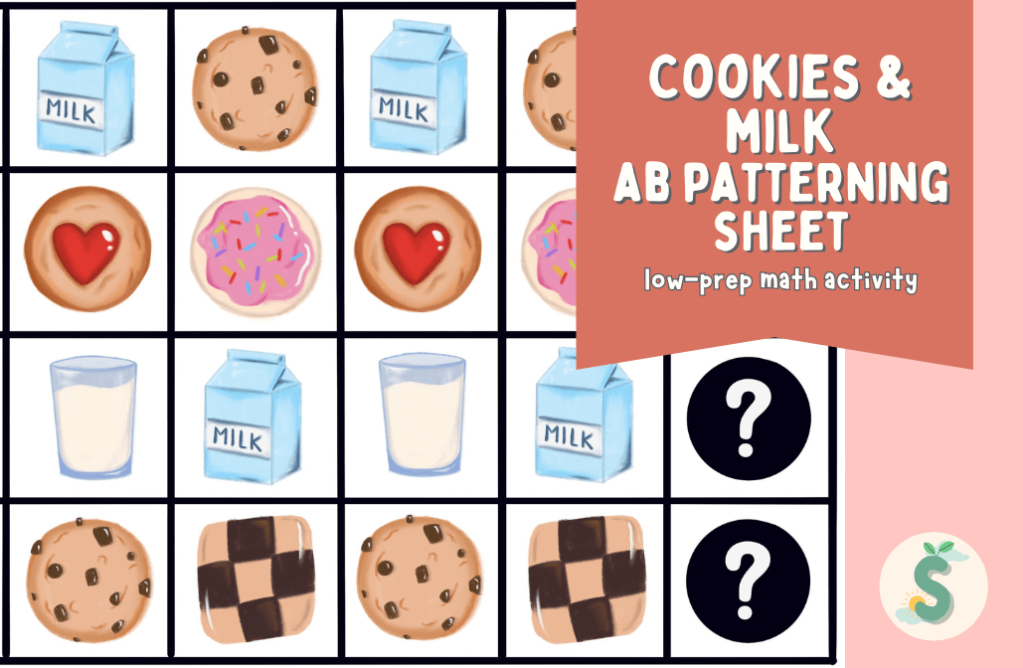
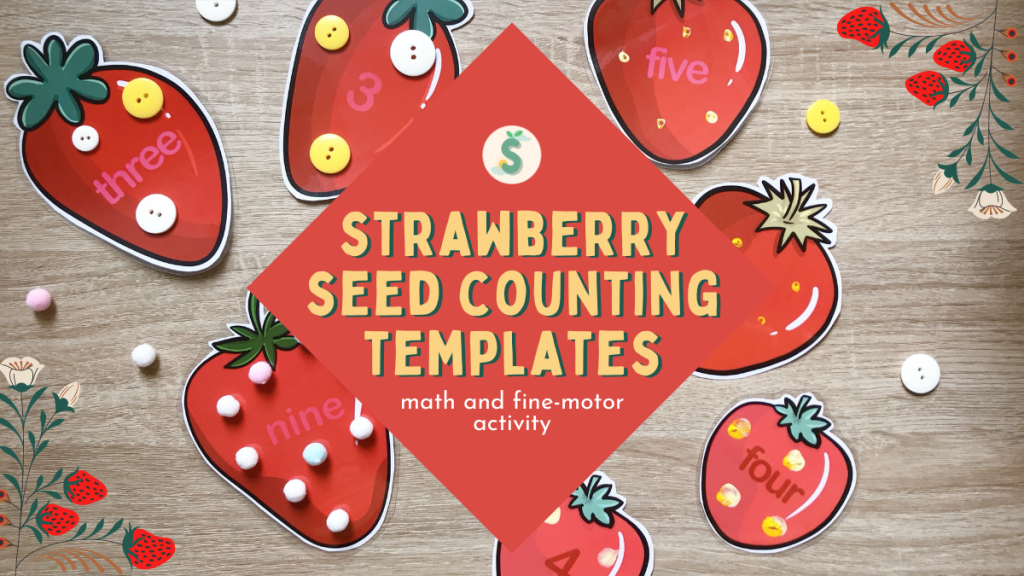
Close-ended questions, activities, or materials can be utilized when you are looking for a specific outcome or answer. For example, in math learning, you’d want to use close-ended activities and ask some close-ended questions to ensure their mathematical understanding.
Open-ended questions are great for analyzing children’s comprehension of new or unfamiliar concepts. They may be used to ask about a child’s emotions, thoughts, feelings, and opinions.
These open-ended questions, materials, and activities help with expanding children’s thinking and understanding and allow for more opportunities for language and conversation. With being open-ended the possibilities are endless!
References
Bullard, J. (2016). Creating Environments for Learning (3rd Edition). Pearson Education (US). https://bookshelf.vitalsource.com/books/9780134014593
Lorina. (2015, September 30). Open Ended Play Materials. Retrieved from https://aussiechildcarenetwork.com.au/articles/teaching-children/open-ended-play-materials



 Sunny Sprouts by Miss Jane
Leave a comment